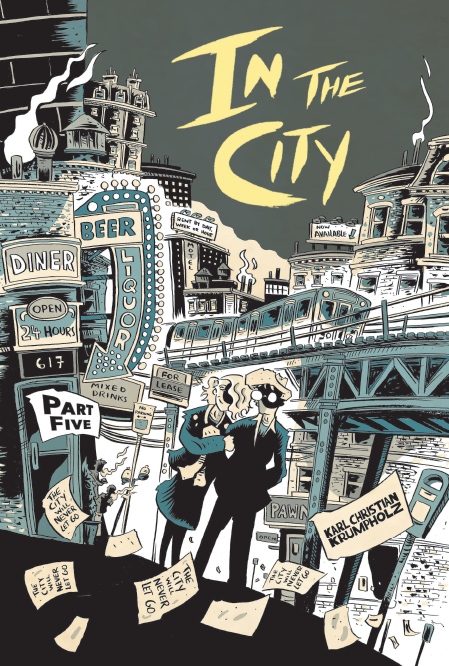
The recent World Cup visit of Scotland’s Tartan Army to cities such as Boston and Providence sparked discussion about the changing nature of urban life, particularly nightlife. Commentators reflected on declining nightlife, rising living costs, social isolation and the loss of communal spaces. Similar questions lie at the heart of Karl Krumpholz’s In the City Part 5.
In In the City Part 5, Karl Krumpholz examines the tension between the city we imagine and the city we actually inhabit. Through pubs, neighbourhoods and everyday encounters, he asks whether a community can survive amid the failures and contradictions of modern American urban life.
Karl draws on the great British writer George Orwell and his essay The Moon Under Water. In this piece of writing, Orwell, like Karl, has a utopian vision of the perfect pub. “If you are asked why you favour a particular public-house, it would seem natural to put the beer first, but the thing that most appeals to me about the Moon Under Water is what people call its ‘atmosphere’.”
The pub that Karl hangs out in is called The Moon Under Water. Does it fit the ideal of the perfect bar? No. But then, as Karl points out, Orwell never found the perfect bar either. Like Orwell, Krumpholz understands that the perfect pub is less a real place than a symbol of belonging and community. Both writers are ultimately concerned with atmosphere, familiarity and human connection rather than architecture or amenities.
Encounters with homelessness, mental illness and public disorder expose the social failures that lie beneath the surface of city life. From a brick through a pub window, to a tense confrontation on the street the dream comes under strain. Both the city and the nation have failed some of its people and there is a price to be paid.
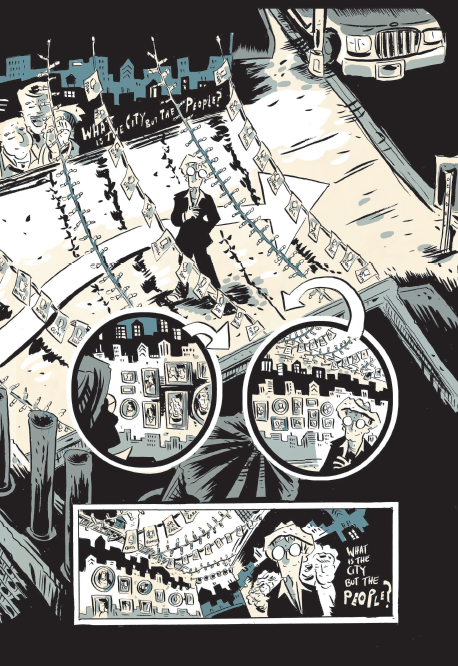
The perfect bar or the perfect society are both created by the thoughts and actions of people. “What is the city but the people?” Karl adopts the role of a flâneur, wandering the around the city and finds reminders of the centrality of social solidarity and remembrance from street portraits (perhaps memorialising COVID victims, though this is not entirely clear) to the ashes of a pub regular which are brought to stay behind the bar.
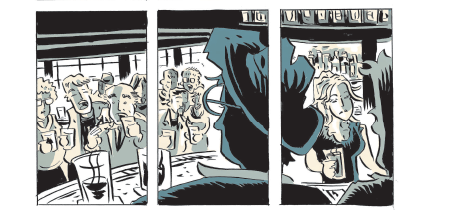
The art in ‘In the City’ has a rounded and almost shimmering quality. The city does not seem like it is made of concrete and glass, but of flesh. It seems alive. Buildings, streets and people seem to merge into a single living organism, reinforcing the book’s view of the city as something organic. The grey-blue colour palette gives it a smoky, cool feeling like a Blue Note album cover. Krumpholz uses a series of wide panels to survey the pub’s clientele, a technique that could perhaps have been used more.
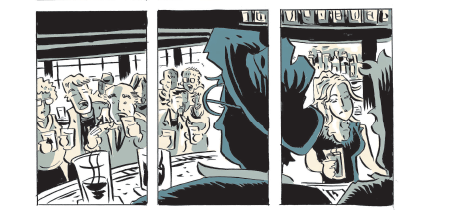
Healthy and vibrant ‘third places’ are a key part of a healthy city whether they are cafes, social centres or bars. When Karl and his partner Kelly try to briefly escape the city they find the small town too limited, stifling and kind of boring.
Ultimately, the city’s true protagonist is the city itself—not its buildings but the collective life of the people who create it. “The city has something for everyone…only because it’s been created by everyone.”
—————–
You can follow Karl Christian Krumholz and get hold of books from the In the City series at his website http://karlchristiankrumpholz.com/
 Daredevils and Warriors