The Golden Age Girls: Understanding Age and Identity: Insights from Comics
An examination of ageing in comics via Cliff Chiang’s Catwoman Lonely City, Jaime Hernandez Locas and Alison Bechdel’s The Secrets of Superhuman Strength.
Ursula K. Le Guin was one of the greatest authors of the Twentieth Century. She was thoughtful, critical and often years ahead of her time. Her astonishing book The Left Hand of Darkness written in the 1970s imagined a society with no gender. As the author of the Earthsea books grew older she reflected on what ageing meant, on how we see ourselves and how our place in society changes as our bodies change.
Perfection is “lean” and “taut” and “hard” — like a boy athlete of twenty, a girl gymnast of twelve. What kind of body is that for a man of fifty or a woman of any age? “Perfect”? What’s perfect? . . . There are a whole lot of ways to be perfect, and not one of them is attained through punishment. (1)
Catwoman: Lonely City. Art and Words by Cliff Chiang
Comics, especially mainstream comics, don’t typically like to talk about ageing. After all, when you talk about ageing you need to talk about death. And what use is a dead piece of intellectual property? There have been exceptions over the years such as the classic strip Gasoline Alley, but one more recent exception is Cliff Chiang’s Catwoman Lonely City – and it really is exceptional.
The young stars of the Gotham City night shone brightly in their twenties and thirties…Harvey Dent, Bruce Wayne, Selina Kyle and all the rest. Where do they go? What happens to them? Some are dead, some have rotted from the inside. Some cling to past glories and reminisce from the bottom of a glass. Others live with their losses and regrets.
In Catwoman Lonely City Selina Kyle has been released from ten years in jail into a very different Gotham City to the one she left. Selina is tough and fit, but bears the scars and niggling injuries of a body that has been fighting all its life. Her body won’t heal in the way it used to. She relies on cortisone injections to keep up the pace.
Catwoman: Lonely City. Art and Words by Cliff Chiang
“I…I know things. I know about your knees, I know about your back spasms. I know you’re not as fast as you used to be. Do I need to go on?” The Emperor Penguin. CLC issue 1
Selina also knows about consequences. Batman and Jim Gordon are dead. She spent ten long years in prison. Life experience has changed others too. The Riddler has sobered up and is coming to terms with grief. Poison Ivy has an older woman’s body and new tactics for a new world.
Cliff Chiang does a wonderful job on characterisation for the cast and visually his designs are perfect. Killer Croc is like a prize-fighter who knows the end is near and wants to go out in a blaze of glory. He always looks sharp in street-wear even if he doesn’t like to be too far from the bathroom.
Through the panels Cliff communicates Selina’s attempts to reconnect with her home town as she walks through the streets of Gotham, each panel showing a different view of the city. Like a movie camera we slowly move to a close up of Selina’s face – the lined face and greying hair of a woman who is still striking but visibly older.
Catwoman: Lonely City. Art and Words by Cliff Chiang
Responsibility also comes with age. Selina has had to take up the mantle of leadership. She is a role model for the younger generation and that comes with a lot of pressure.
Catwoman Lonely City is part of the Black Label series from DC. It is a one-off and not part of regular DC continuity. We have not seen Selina age over the years. One comic that did take that unusual step was Love and Rockets by Jaime and Gilbert Hernandez.
Art by Jaime Hernandez
The epic illustrated soap opera has aged its characters in real time, most notably in Jaime’s Locas strip. We have followed all of the characters, and especially Maggie and Hopey, from their angst ridden teenage rebel years to their present day experiences. Instead of throwing bottles at the cops after an Ape Sex gig, our heroines are more likely to be sneaking out to get an early night.
Maggie faces problems such as how to get on with younger people, particularly in her encounters with bumbling Tonta. We also explore how friendships change over time, particularly the friendship of Maggie and Hopey, from the intense connections of youth to that between two adults who have their own lives.
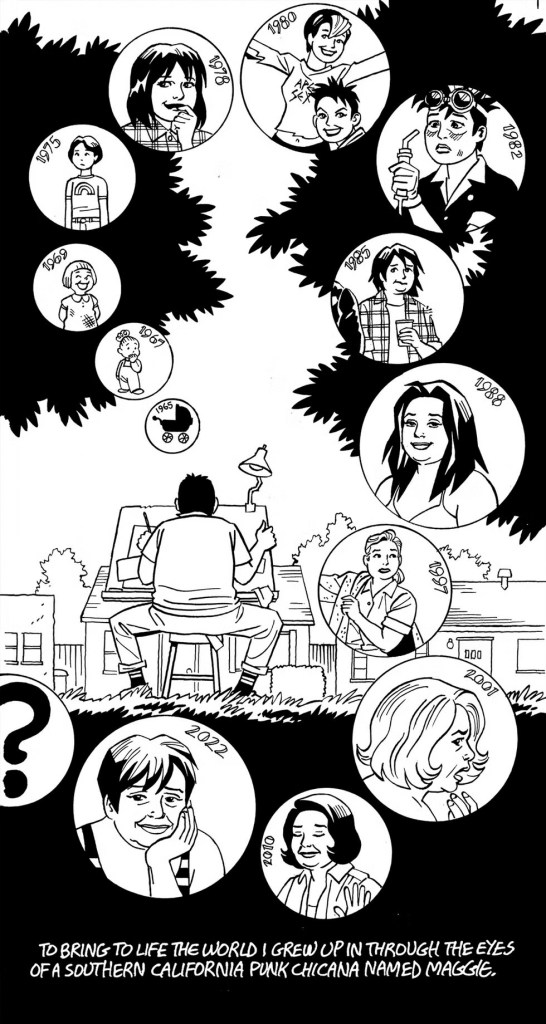
In a recent illustration Jaime did for the Alta Journal Book Club (2) he shows himself hunched over a drawing board. Emerging from his pencil are years of depictions of Maggie, from baby, to skinny teenager to middle aged woman. Cliff Chiang’s Catwoman shows us that the past is always with us, it permeates our life and defines what our life means – in our memories, in our love for our friends, in our grief at their loss. Jaime shows us the same.
Art and Words by Jaime Hernandez
We change, in fact change is positive and unavoidable. But the resonances of what makes our life always remain. Lovers, family, friends of course but also culture and place. Maggie and Hopey will always have the town of Hoppers, their latin culture and their punk roots. Selina will always have Gotham City. Maybe the alleys and rooftops of the city are her real true love.
The disconnect between our self-image and the realities of our ageing bodies are also explored in Alison Bechdel’s The Secret to Superhuman Strength. Bechdel is one of the greatest autobiographical comic writers of all time. Whilst famous for the ‘Bechdel test’ – a throwaway remark she made about women characters in movies – her book Fun Home was a landmark for autobiographical comics.
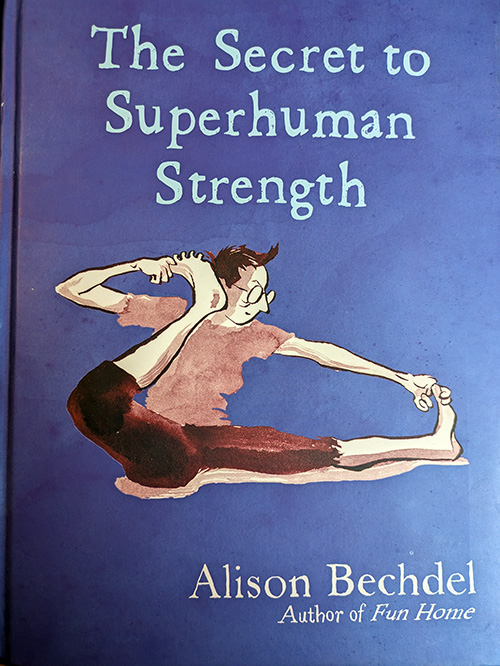
Cover of the Secret to Superhuman Strength by Alison Bechdel
The Secret to Superhuman Strength is also an autobiographical work which explores the author’s relationship to exercise. Running, martial arts and cycling are among the sometimes obsessive activities which are a core part of her identity. Through her work, her relationship with her family, her identity as a gay woman and feminist, exercise is a constant.
But if your goal is to have ‘superhuman strength’ then how do you reconcile that with the realities of ageing? Just as Selina learns she cannot leap across the rooftops in the way she used to, or Maggie learns that the mosh pit of a hardcore gig might not be for her anymore, so Alison Bechdel has to come to terms with her changing body in a changing world. Hitting 40 and hitting the bottle. Dealing with the shock of the menopause.
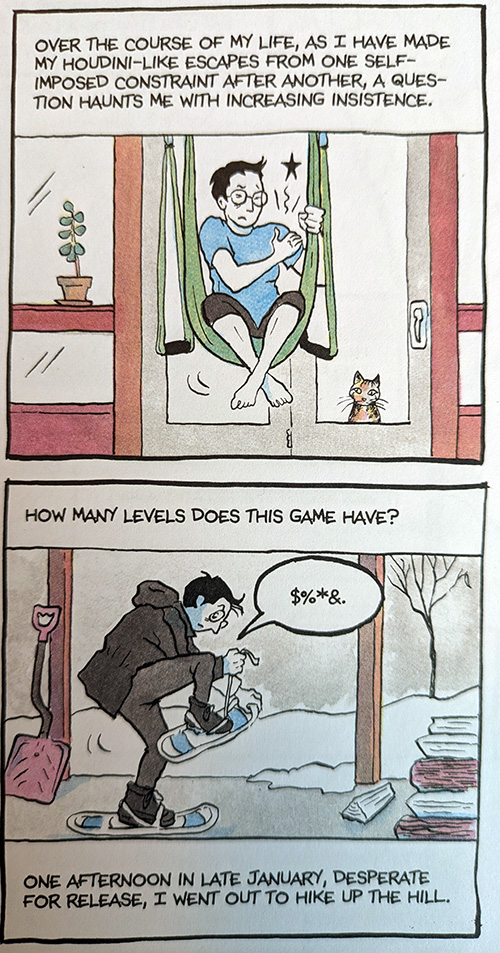
“Over the course of my life, as I have made my Houdini-like escapes from one self-imposed constraint after another, a question haunts me with increasing insistence. How many levels does this game have?” The Secret to Superhuman Strength pg 199
The Secret to Superhuman Strength. Art and Words by Alison Bechdel
Comics is a perfect medium to represent the human body as it runs, climbs and yoga-stretches. Bechdel masters the physicality of the topic and the movement of the figure.
Ageing is a universal experience, one that every writer and artist will experience, if they are lucky. Comics can represent this visually, without relying on actors with their cgi and prosthetics. Maybe the subject is not one that is seen as being commercial, but many of the best comics are not very commercial.
So thank you Cliff Chiang, Jaime Hernandez and Alison Bechdel. I’ll give the last word to the late Agnès Varda, one of the great film-makers of our times. Agnès kept making films and art throughout her life and she reflected on how much more interesting that was than just talking about the young and beautiful. “I love to see things age and move and become something else. I’ve loved ageing, really, and I love to look at things.” (3)
The Wave in the Mind: Talks and Essays on the Writer, the Reader, and the Imagination. Ursula K. Le Guin, 2004
This is a blog dedicated to what I have been lucky enough to find out about comics. I might add in some other geeky goodness, but it's mainly about the comics.



 Daredevils and Warriors