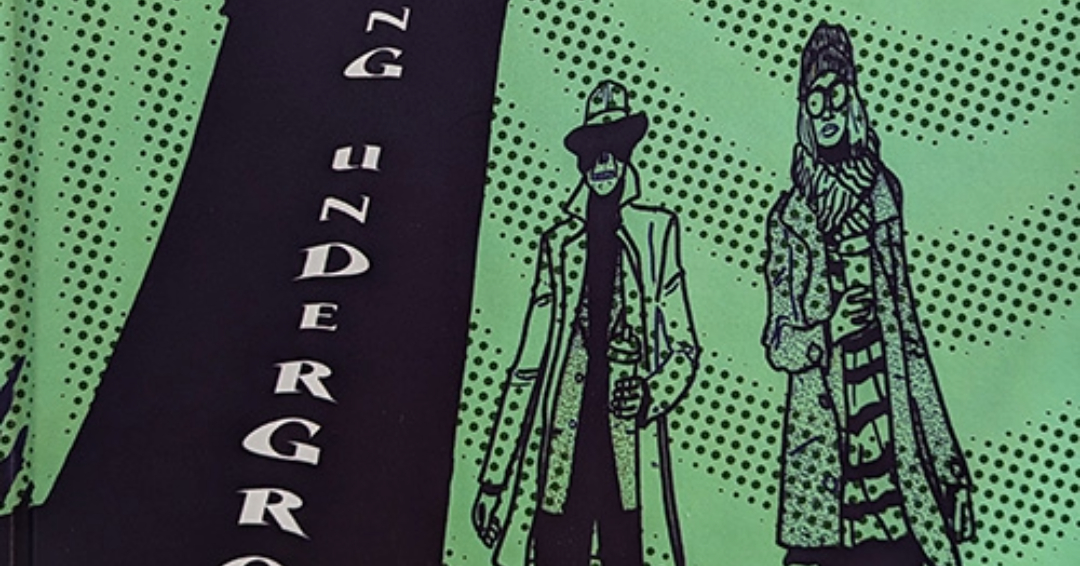
The United: Going Underground by Jonny Cannon

Who doesn’t love a slightly-off alt-historical setting for a comic? Nostalgic but unsettling. The near future as someone from the 70s or maybe the 80s might have viewed it. If this sounds like the type of vibe that Alan Moore consistently went for in strips like Captain Britain and V for Vendetta, then you would be on the right path. This is the world of The United: Going Underground.
How do you set the scene for a comic set in this vision of Britain? How about an abandoned Tube station, hipster goons straight from Hoxton central casting, complete with Peaky Blinders hats, neckerchiefs and beards that are no stranger to beard-oil. Throw in a psychotic and psychedelic pink hippo that will be all too familiar to those, like me, who spent their afternoons watching double bills of Rainbow when they should have been at double games. Up above the trees and houses. Oh, and then skip to an allotment.

This version of England’s dreaming continues the story from the first volume ‘The United: Welcome to the Shitshow’. Jonny Cannon’s world brought us constitutional upheaval as real world debates around Scottish independence echo in a story about class, power and violence. Now the UK is dead and in Going Underground we come up to date with the new powers in Britain and the Republic of Scotland and the forces ranged against them. Whether the modern day Cromwellian commonwealth of the Great Leveller or the revanchist opposition, it is power and brutality that decides who wins.
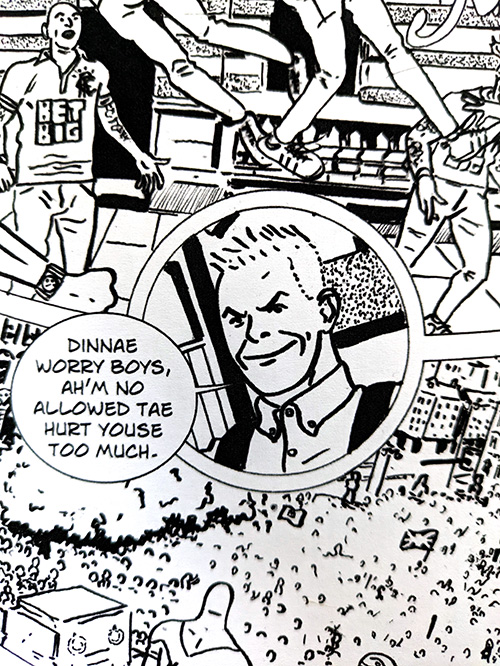
The world-building is one of the most satisfying elements of the book. The new Scottish Republic has its own super team – The Brave and a rather unique WMD. Unhappy loyalists take to the streets during ‘marching season’ and are met with a team including a certain dungaree wearing, bucket sitting staple of Scottish comics. Jings. All the new heroes are lovingly designed and put me in mind of Kurt Busiek’s Astro City, albeit a bit more scatalogical. I definitely want to see some of these costumes in colour, Official Handbook of the Marvel Universe style.
This volume sees skull-faced detective Jimmy Pilgrim take centre stage. Pilgrim is a little bit hard-boiled film noir detective and a little pulp hooded menace with a dash of Hulk Weekly Night-Raven. David Lloyd’s work on V for Vendetta and Night-Raven certainly came to mind when reading this book.
The book is in black and white and this provides plenty of opportunity to emphasise that noir element, as Pilgrim stalks the night-time alleyways. Blacked out panels with eyes emerging from the darkness, splashes of light falling on alleyways, cigarettes illuminating faces.

Jonny is well known as a student of the comic greats and there are some very imaginative uses of panels. Eisneresque titles, changes of orientation, panels contained within falling autumn leaves and within the pieces of a jigsaw puzzle. In the swaying body of a stripper I detected the sinewy influence of Jaime Hernandez.
As the story develops we go further underground into the secret hidden chambers of the city, into the lost tube stations and forgotten tunnels. Our characters descend into the darkness too with some shocking twists. Jonny told me “I really wanted an ending that would stick in folks minds for a while. I changed the writing style to unsettle the reader again. It’s actually the approach that Foster used on Prince Valiant. I dropped the word balloons and went for a hidden narrator. I tried to create a sense of dread and horror throughout the book.”

The United: Going Underground builds effectively on the first volume of the series. It shows real progression in storytelling and is imbued with a love of the comics medium and a real understanding of how it manifests in British society. But most importantly it is a great read. I would have loved reading this at age 10 and I love reading it now. I hope we will have a lot more from the world of The United.
Order your copy of The United: Going Underground at the Cannonhill Comics website.
 Daredevils and Warriors