The music of The Pogues and comics.
When people think of the Pogues and especially the band’s astonishingly gifted Bacchanalian frontman Shane MacGowan, they might think of drunken Irish jigs with a sprinkling of censored Christmas tinsel. But look beyond the greatest hits served up by the algorithm and you will find songs of astonishing beauty, poignancy and sometimes anger.
I personally consider The Pogues to be the greatest London band. They told the story of the Irish diaspora community around the world – New York, Chicago but especially London where the band formed. Songs like Dark Streets of London, Misty Morning, Albert Bridge, Rainy Night in Soho, Lullaby of London and London Girl told the story of a city that was formed by its immigrant communities. It especially told of the Irish who came to London in large numbers looking for a better life.
Going Transmetropolitan, yip aye ay.
Transmetropolitan was a song, a hell of a song. In fact it was the first song on the Pogues debut album Red Roses for Me. It tells a tale of a riotous journey across London by a group of hellraisers you probably wouldn’t want to encounter on the night bus.
From a five pound bet in William Hills to a Soho sex-shop dream/From a fried egg in Valtaro’s to a Tottenham Court Road ice cream/We’ll spew and lurch, get nicked and fixed, on the way we’ll kill and maim/When you haven’t got a penny, boys, it’s all the bloody same/Going transmetropolitan (yip-ay-yay)/From Surrey Docks to Somers Town/With a KMRIA
The Pogues – Transmetropolitan
With a KMRIA? Kiss my Royal Irish Arse, in case you were wondering.
Transmetropolitan is, of course, also a comic. It is one of the great comics that defined a great era of DC Vertigo. Vertigo remains one of the great comic labels of all time, publishing ground breaking work like Sandman and Hellblazer – a critical and commercial success that the modern comics industry would dream of replicating.

Written in 1997, 13 years after the release of Red Roses for Me, it tells the tale of Spider Jerusalem – his name itself a call back to Pogues member Spider Stacey who along with MacGowan founded the band with a gig in a New Romantic club, an event alluded to in the songs reference to Camden Palace. Spider is a gonzo journalist in the mode of Hunter S. Thompson (whose chaotic prose is less in vogue these days but, let me tell you, was the last word in hip in the 80’s and 90’s.)
Transmetropolitan is set in the future – but like all science fiction – it is about our present day society. Cyberpunk, transhumanism, the idea that we will be able to hack and upgrade the human body. Spider is in conflict with his government and often with the society in which he lives. The first issue is titled ‘In the Summer of the Year’ – a line from the Pogues song.
Spider fights against an oppressive and Orwellian government in a battle, as referenced in the song. The song alludes to Arlington House, where both Orwell and Brendan Behan resided. The protagonist’s relationship with the city is similar to that of the song’s characters with London. They belong to the city, yet they are outsiders, part of an ‘othered’ community. They express their discontent with the city through profanity-laced anger.
Spider Jerusalem is an extreme figure – in his appetite for tobacco, drugs and guns. But he is a talented writer. The shade of Shane MacGowan is not far away from him.
Lend me ten pounds and I’ll buy you a drink
When Alan Moore, Steve Bisette and John Totleben first created the character of John Constantine in the pages of Swamp Thing, he was styled after the lead singer of the Police, Sting. Bisette said he was compelled to draw Sting into the book, so Alan had better write a character to fit. Having thus manifested himself, Constantine proved a popular character and soon had his own book…Hellblazer (the original and better title Hellraiser had to be dropped when a certain horror film was announced.) But it was not the Police, but the Pogues who came to be more closely linked to the book.
Original Hellblazer writer Jamie Delano established Constantine’s tortured ex-punk chain smoking smart arse sorcerer persona. When Northern Irish writer Garth Ennis took over the writing for Hellblazer he expanded on themes of the Irish experience including his own difficult encounters with religion. Describing Constantine as “not a nice man, but a great character to write”(1), Garth took Constantine in some new directions.
One of the key themes of the book under Garth Ennis was the drink. Alcohol and the good life, its pleasures and perils. In the story ‘A Drop of the Hard Stuff’ he reunites with an old Irish friend Brendan, who has literally sold his soul to the devil in exchange for a magnificent collection of booze. Was Brendan a reference to Brendan Behan, famed Irish writer, and a man often seen as for whom alcohol was a muse?
Brendan reappears again in the issue ‘Confessions of an Irish Rebel’ going out for a post-mortal pint in ghostly form with John as they go on a Dublin pub crawl and reflect on the state of Ireland and the state of the world.
Behan is a common reference point for the Pogues. The band’s relationship to alcohol is well known, booze and drugs both fed and devoured the talent of Shane MacGowan. The band were the latest to kindle the romantic myth linking drink to creativity. Sinead O’Connor said of MacGowan “he’s operating on two engines when he has four. He’s a genius when he’s fucked up, imagine how much more of a genius he would be if he wasn’t” (2).
Speaking to a French journalist Shane MacGowan said that in England drinking “was something you sweep under the carpet. In Ireland its more open. Everyone can understand you wanting a drink.”(3)
Both MacGowan and Garth Ennis excel in depicting the warm, communal experience of a night in the pub, a night of laughter and friendship and we are back in the boozer for the story ‘The Pub Where I was Born’ – the title a line from the Pogues song Sally MacLennan. The tale of the Northampton Arms (maybe a reference to Northampton based Alan Moore) pits all of the positive elements of the pub, the sense of community, camaraderie and refuge against rapacious property developers, fascists and gangsters.

For young Irish people who found themselves in London, the pub was a refuge, but one that came at a price. One Irishwoman in London recalled (4)
“But fellas, oh God yes, fellas drank. To be honest, looking at that now, a lot of that was loneliness. A lot of them came from big families and were now living on their own, in one room in Cricklewood. They went looking for companionship. And going to the pub five or six nights a week for companionship, the drink got a hold of them without them realising it.”
Phyllis Izzard quoted in An Unconsidered People – The Irish in London by Catherine Dunne
But it is the story Lord of the Dance which really epitomises the centrality of drinking in the Ennis’ Hellblazer world. In this story the eponymous Lord has been cast into a sober exile by a censorious church. Constantine takes him for a few Christmas Eve pints to help restore his pagan presence in modern day London. The issue ends with two drunken Londoners (who might bear a resemblance to the book’s creative team) weaving their way through the city.

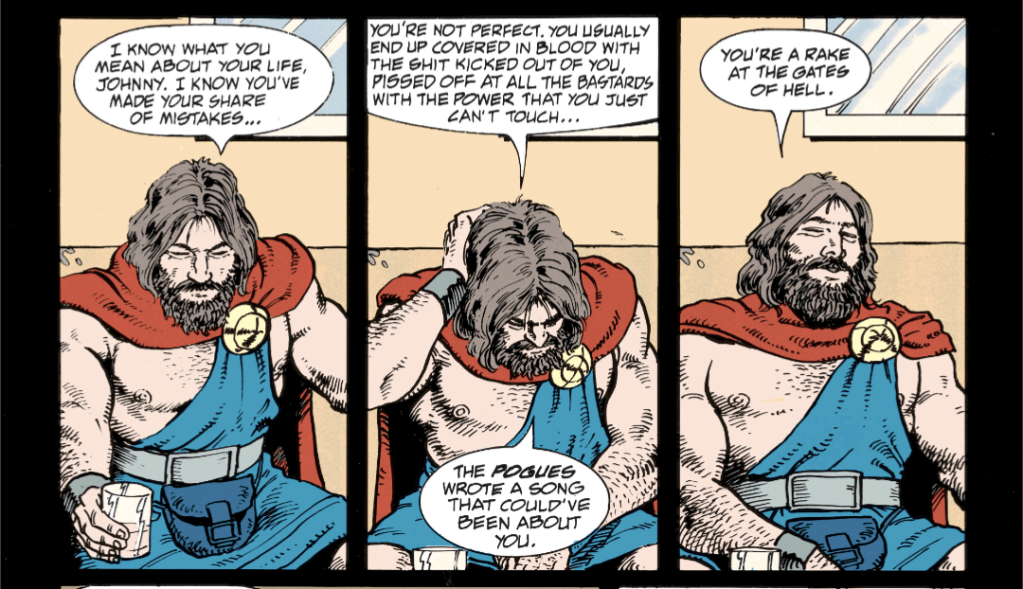
The Lord of the Dance makes a return appearance for Constantine’s fortieth birthday party in issue 63 alongside most of his supporting cast including Swamp Thing and Zatanna. In this classic issue we again see the warmth and communal spirit of getting together for a party, with a few drinks and a big bush of cannabis courtesy of the swamp monster. Steve Dillon again provides the artwork. The issue ends with Garth Ennis making his most direct reference to The Pogues in the issue as the Lord of the Dance muses on Constantine’s life:
You’re not perfect. You usually end up covered in blood with the shit kicked out of you, pissed off at all the bastards with the power that you just can’t touch…The Pogues wrote a song that could’ve been about you. You’re a rake at the gates of hell.
Does Hellblazer romanticize drinking? Sometimes, but we also see the negative side as Constantine goes on a post-breakup bender. Instead of celebrating the married couple running a pub, as in The Pub Where I Was Born, he finds himself cursing them and being barred. He ends up on a downward spiral that leads to homelessness, drinking whatever he can get his hands on to black out the memory of what he has lost. That story is named after a Pogues song too. Down All the Days – which originally told the story of Christy Brown, the Irish writer with cerebral palsy who was the subject of the film My Left Foot. But it is their song The Old Main Drag, a tale of a young Irish man homeless in London, that it more closely resembles.
Rake at the Gates of Hell
Watch the maggots crawl out of them
Hear the angels call above them
Swaying around as the cold air sucks them
Down to hell, good night, good luck then
The Pogues – Rake at the Gates of Hell

Resistance to the stifling hand of organised religion is the other theme in this story. Under Garth Ennis Heaven and Hell will increasingly be physically present in Hellblazer. Angels and demons walk the streets of London, which is the city of Milton and Marlowe as well as MacGowan and Constantine. Corrupt priests and ‘stormtrooper’ angels are portrayed as acting in the name of an insane deity.
As Constantine bargains and connives against diabolical forces to save himself from lung cancer we see the jealous and bitter forces of hell manifest themselves. Ennis draws directly on the imagery of the Catholic church. Demons appear to Constantine in the form of the crucified Christ. Artist Will Simpson hints at the nails and ropes binding his limbs throughout the book until the final splash page reveal – no holding back on the imagery in this book!

Irish journalist Fintan O’Toole writes about Irish artists’ relationship with the church (5);
“they could at once rail against Catholicism and raid its vast storehouse of imagery, knowing that their audience could still be touched by the power of its iconography. They could be both sacrilegious and sacramental”
Fintan O’Toole We Don’t Know Ourselves – A personal history of Ireland since 1958 pg 506
The Pogues often touch on the heavy hand of religion and the impact it has had on the Irish and the Irish diaspora. The Irish Republic of De Valera worked hand in hand with the church for decades in its goal of building a Gaelic speaking, nationalist, catholic state. The bishops had power over all issues of ‘morality’ – divorce and abortion were illegal and the church censored books, TV and film. The song Thousands are Sailing, written by the late Phil Chevron, dealt with the Irish emigrant experience in the U.S. and included reflection on the catholic church.
Where’er we go we celebrate the land that makes us refugees
from fear of priests with empty plates
from guilt, and weeping effigies
The Pogues – Thousands are Sailing
By the 1980s when the Pogues began recording, the Republic was turning its back on the vision of De Valera. The entry of Ireland into first the EEC and then the EU and the days of the ‘celtic tiger’ brought first economic change and then cultural change. In the 1930s Ireland had emigration rates of up to 45%. Even into the 1960s many rural households in what was then a predominantly rural country had no running water or electricity.
But the church was an enduring presence in the subconscious of the nation as was its belief that it should have the final say in issues of ‘morality’. Divorce would not be legal until 1995, abortion in 2018 and same-sex sexual activity decriminalised in 1993.
We see this influence at work in Hellblazer. Hell and all of its torments are very real and are waiting for the sinner. John Constantine has given the finger to Heaven and Hell alike and a terrible price awaits him.
The above tale also sees the welcome presence of the late Steve Dillon, an artist who would go on to work with Garth Ennis on the seminal Preacher story for Vertigo. His warm and fluid style is perfect for Constantine and a big improvement on the previous artists who had odd habits of adding yellow cabs and New York police uniforms to London scenes.
A Pair of Brown Eyes

Constantine also renews his acquaintance with the ex of his late friend Brendan, Kit. This classic black haired, green eyed Irish beauty is another element that places Irish themes as central in the book. Cover artist Glenn Fabry does a wonderful job at bringing Kit to life on several classic Hellblazer covers.
Constantine finds peace with Kit, but of course his past is never far away. His many enemies, from the First of the Fallen to the King of Vampires hound him at every opportunity. Unwilling to turn his back on magic he loses his great love and falls into despair.
We even see Kit in a stand alone issue ‘Heartland’ where we learn more about her life in Belfast and get a glimpse of what John has lost. She returns in the penultimate issue of Ennis’ run in the Rake at the Gates of Hell storyline – with each issue in the run named after a Pogues song. This issue represents a coda. However Kit challenges the romantic notion of Brendan that life is a song. She fears that people, like Brendan and John, always fall back to their old ways.
Tragic love and lovers that were ‘not meant to be’ recur repeatedly in Hellblazer. The succubus Ellie seduces but then falls in love with an angel named Tali. Even archangel Gabriel is not immune to a moment of weakness with terrible consequences.

In the world of Constantine love is serious magic and like all magic comes with consequences. The consequences of his past betrayals and double crosses of friends and foes alike. But also the consequences of his lifestyle as he deals with lung cancer caused not by a demon, but by a lifetime of smoking.
Kit sees Constantine for what he is, he will not change. As Ennis’ run on the book came to an end he was really expressing his own feelings about John Constantine “I’ve known a few too many lovable rogue/wide-boy types in real life to find the notion attractive, people who abuse their friends, disappear for a while, then come back and do it again because they know they’ll be forgiven” (6)

I’m a Man You Don’t Meet Everyday
Garth Ennis was to go on to write the hit book Preacher and returned to many of the themes seen in Hellblazer. His Irish vampire Cassidy served as a conduit for many of the themes of the Irish experience encountered in Hellblazer. The romance between central character Jesse Custer and Tulip O’Hare is explored in issues with titles like “I Built My Dreams Around You”.
The music of the Pogues was to inspire thousands of great creatives. The incredible TV show The Wire drew repeatedly on the bands musical spirit and Shane MacGowan has been the subject of numerous documentaries including the recent film Crock of Gold from director Julian Temple.
But maybe it is in comics that we have seen some of the strongest inspiration and synergy. From the dark streets of London to the gates of Hell. With a KMRIA.
Notes
1. Garth Ennis: Hellblazer Interview
2. BBC Documentary The Great Hunger, the Songs of Shane MacGowan 1997
3. The Pogues – Les enfants du rock (1986)[EN subs]
4. Phyllis Izzard quoted in An Unconsidered People – The Irish in London by Catherine Dunne
5. Fintan O’Toole We Don’t Know Ourselves – A personal history of Ireland since 1958 pg 506
6. The Vulture – A Secret History of John Constantine
For more on John Constantine’s origins and working class scally psychedelia see the article on this site John Constantine – The City and the Swamp.
 Daredevils and Warriors